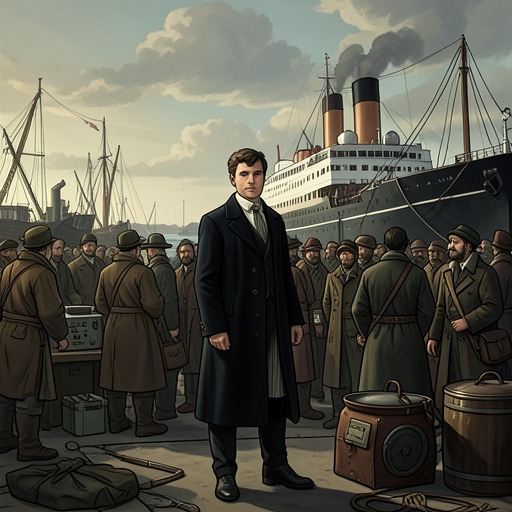
Passepartout Joins Batulcar’s Troupe and Reunites with Fogg
Around the World in Eighty DaysPassepartout Joins Batulcar’s Troupe and Reunites with Fogg is the Yokohama episode in which Passepartout turns hunger and isolation into an unlikely route forward, then finds Phileas Fogg and Aouda by accident in the middle of a performance. The reunion closes the separation caused by his missing the Carnatic, while the collapsed human pyramid makes his return as abrupt and disruptive as his disappearance.
Separation and Predicament
Passepartout reaches Yokohama aboard the Carnatic, but without Fogg or Aouda. His passage has been paid in advance, yet he has no money at all—not even a penny—and is left with only five or six days to decide what to do next. The port’s connections among North America, China, Japan, and the surrounding islands place him at a major crossroads, but for him its global traffic initially sharpens rather than solves the problem: he is alone and has no obvious means of continuing the journey.
He wanders through Yokohama without a plan, first entering the European quarter, where low-fronted houses with verandas stand among streets, squares, docks, and warehouses. The crowds include Americans, English people, Chinese people, and Dutch people, many of them merchants. The variety around him does not give him a foothold; he feels as isolated in the crowd as if he had arrived among strangers in a wholly unfamiliar world. The mismatch between an international port and his personal helplessness gives the episode its starting tension.
Making a Passage Out of Hunger
By the following morning, Passepartout is exhausted and famished. He considers selling his watch but cannot bring himself to do so. Instead, he decides to use his strong voice to earn money by singing French and English songs. He waits rather than stage a concert too early, and then recognizes that his European clothes would not suit the life of a wandering performer. A search for an old-clothes dealer leads him to exchange them for Japanese dress; afterward, he eats half a bird and a little rice at a modest tea-house.
Food settles the immediate hunger, not the larger problem. Passepartout resolves to leave Japan as soon as possible and considers offering himself as a cook or servant aboard an American steamer in return for passage and meals. San Francisco would give him a place from which to work out the next stage, but the Pacific Ocean presents a daunting crossing of 4,700 miles. As he approaches the docks, he begins to doubt whether a ship would employ him or trust him without references, especially in his unfamiliar clothing. His plan is resourceful but not yet credible to the people whose help he needs.
An Improvised Engagement
A placard carried through the streets catches Passepartout’s attention: it advertises William Batulcar’s Acrobatic Troupe. The prospect answers his immediate need for work and offers a route toward San Francisco. The engagement is concluded on the spot. Passepartout is hired by the Japanese troupe, not because the position is dignified, but because it gives him food and a prospect of leaving Japan within a week.
The job quickly makes his body part of the spectacle. For the troupe’s final attraction, fifty performers are to represent the Car of Juggernaut by building a human pyramid on their long artificial noses. The performer who had formed its base has left, and Passepartout is selected as his replacement because strength and agility are what the part requires. He puts on a costume with multicoloured wings and fastens a six-foot false nose to his own. The disguise is an expedient exchange: the costume that helps him earn his next meal also makes him nearly unrecognizable to anyone searching for him.
The Pyramid Breaks and the Party Reunites
During the performance, the artists lie on their backs as the pyramid rises in successive tiers above their noses, eventually reaching the theatre’s cornices. The construction is precarious by design; applause and the orchestra’s loud music accompany its final moments. Then Passepartout sees Phileas Fogg in the gallery. He abandons his place at the base, clears the footlights without using his wings, and scrambles toward his master, crying out to him. His movement removes one of the pyramid’s supports, and the human monument collapses onto the stage.
Fogg answers with recognition and an immediate instruction to go to the steamer. Aouda and Fogg leave the theatre with Passepartout, while William Batulcar, furious at the broken formation, demands compensation. Fogg appeases him with a handful of banknotes. The payment resolves the immediate dispute and allows the reunited party to leave without letting the damage to the show derail their departure.
The Search, the Reunion, and Its Aftermath
The reunion is the outcome of two converging searches. Fogg and Aouda have learned that Passepartout arrived at Yokohama the day before aboard the Carnatic. With the steamer for San Francisco due to leave that evening, Fogg searches urgently, applying in vain to the French and English consuls and then walking the streets for a long time. He enters Batulcar’s theatre by chance—or, as the narration allows, perhaps through presentiment. Fogg would not have recognized Passepartout in the performer’s eccentric costume; Passepartout, lying on his back in the gallery’s view, recognizes his master and cannot suppress his reaction. The resulting collapse turns an accidental sighting into an unmistakable reunion.
Aouda is greatly delighted to learn that Passepartout has arrived, and perhaps Fogg is as well, though he shows no emotion. Passepartout gives an account of his absence that omits what occurred between him and Fix: he says only that he was overtaken by drunkenness after smoking opium at a tavern in Hong Kong. Fogg listens without comment and gives him money for clothes more suited to his position. Within an hour, Passepartout has cut off the false nose and discarded the wings; nothing remains of the Tingou performer’s costume.
Narrative Significance
The episode sets Passepartout’s improvisation against Fogg’s steadiness. On the Mongolia, Fogg had shown no outward anxiety during the Red Sea’s rough weather; in Bombay, he had ignored the city’s sights and kept to the demands of his schedule. In Yokohama, that same forward momentum depends on a servant who has survived separation by adapting from one expedient to another: song, an exchange of clothes, a meal, a proposed shipboard job, and finally acrobatics. The contrast makes their reunion more than a return to the previous arrangement: Fogg’s journey can continue because Passepartout has improvised a way back into it.
The theatre gives that return a sharply physical form. Passepartout’s disguise makes him difficult for Fogg to recognize, while his recognition of Fogg makes him abandon the very position that keeps the performance standing. The resulting collapse is both comic consequence and plot mechanism: his failure to remain in the act brings him back into the journey. Once Fogg pays Batulcar, the troupe’s spectacle yields to the party’s imminent departure. The steamer named for the next leg is the General Grant, bound from Yokohama to San Francisco, and Passepartout is once again with Fogg and Aouda as the route resumes.